All posts by Meandering Moonsong

Dreams of travelling the world - exploring abandoned ruins, wandering through enchanted forests, discovering mysterious caves, and navigating through uncharted seas, have always haunted my thoughts. Ever since I was a little girl, reading Enid Blyton's Faraway Tree stories, adventuring with Alice to Wonderland, and then later on during my teenage years, discovering epics such as Tolkien's Lord of the Rings, Pratchett's Discworld and Dianna Wynne Jones' Chrestomancy book series, among many others.​ How could I not dream of crumbling castles, rugged coasts and different cultures? Finally, in my twenties, I found the courage to look up from my books, and start exploring the world... one step at a time. Oh I almost forgot to try and 'describe' myself - I'm a nerdish Wiccan metalhead from Malta, a freelance writer, book-hoarder, food-lover, stubborn anime and Asian-drama fan, deliciously entranced with all things horror and creepy.

The Punkva Caves and the Macocha Abyss

The subterranean Punkva River, being almost 30 kilometers in length, is the longest underground river in the Czech Republic. It is thanks to the erosion, fluctuation and twisting flows of its many tributaries that an extensive system of underground passages, domes and abysses was formed underneath what is known as the Moravian Karst, a protected nature reserve on the eastern part of the Czech Republic.

This beautiful region is home to a number of unique geological features, not least of which are a number of cave systems underlying the lush green woodlands and forests. The most famous of these cave networks are the Punkva Caves located to the north of the city of Brno, which showcase one of the natural wonders of the Czech Republic – the Macocha Gorge.

Fortunately, we had researched our destination well before actually visiting the caves and so realized early on that they could only be accessed through a guided tour. Since tours of the caves only take place at allocated times, not to mention the fact that the place is a famous tourist attraction, it is important for anyone interested in visiting to book the tour beforehand.

We bought our tickets online, yet still had to visit the Visitor’s Center to exchange our e-mail with the actual tickets. While there, we were also told that if we wanted to take photographs in the caves, we had to purchase a colored sticker for a small fee and attach it to our clothes. This may seem strange, but it is common procedure in certain countries.

Armed with tickets, stickers, cameras and expectations, we boarded the small tram from the Visitor’s Center to the entrance of the Punkva Caves. One can, of course, opt to walk the two-kilometer woodland trail instead of using the tram. Once we arrived in front of the entrance, I abruptly realized that it would be much colder underground, and that the light clothes I was wearing, suitable for a stroll in the sun, were definitely not enough for the freezing caves.

There was only the official merchandise store nearby, so I hurried over and bought a bright red ‘Punkva Caves’ sweater for the occasion. It did keep me warm during the one-hour tour and was also a very nice souvenir. At least I had the good sense to wear comfortable sneakers.

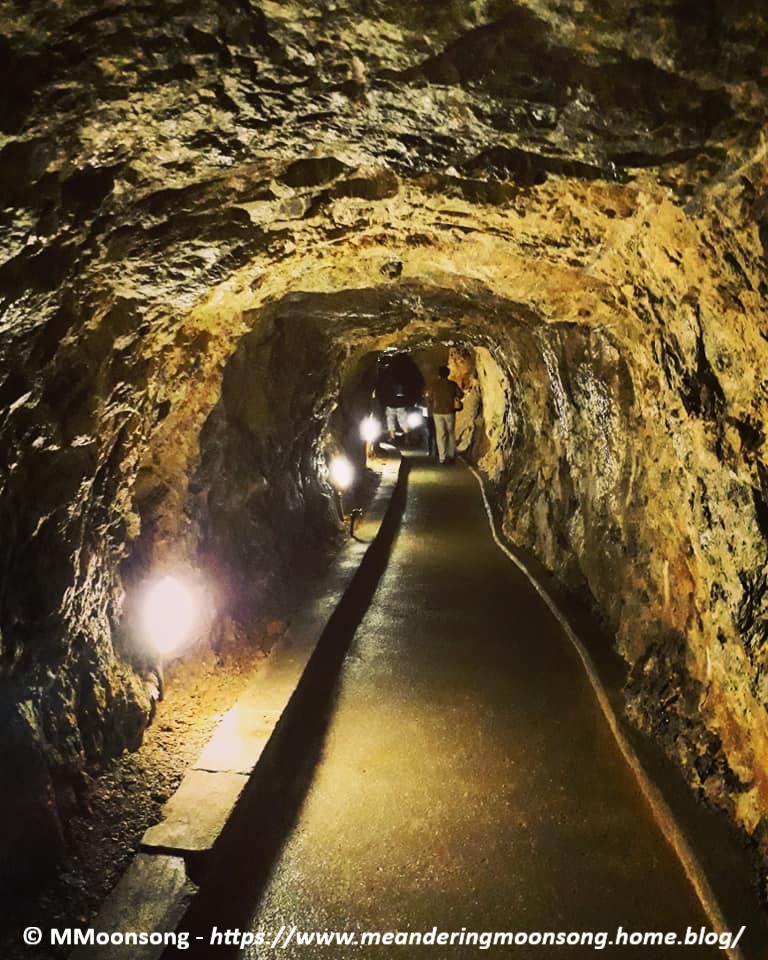
Our group was made of around 30 people. I was glad to see that there were even small children and senior citizens – a clear indication that there were no dangerous, unsecured sheer drops or rough terrain to climb ahead. After all, one does not need to be a miner to explore the Great Underground! The caves are, in fact, very safe for visitors, being equipped with plenty of lighting and having level floors and stairs. Unfortunately, it was at this point that we realised that the tour was in Czech and that there were no tours in English available. However, I had previously found and downloaded a free mobile application with a tour book of the caves on my mobile phone and I found that very helpful.

The tour itself is actually divided in two parts. The first part is on foot, while the second consists of a very atmospheric boat-ride on the subterranean Punkva River.
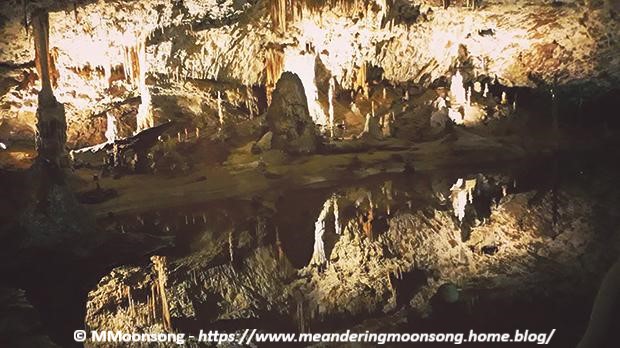
Mirror Lake

As we entered the caves, a four-metre-long stalactite welcomed us in the Front Dome, a large, hall-like space filled with myriad stalactites and stalagmites. Walking on, I was literally mesmerised as I encountered the Mirror Lake, whose waters are so clear as to leave one in total awe. Two worlds seemed to meet, divided by the water’s surface, as the crystalline stalactites met their counterpart through the underground lake’s reflection.

Steep steps took us up a 10-metre shaft-like tunnel leading to what is known as the Dome of Destruction, in reference to a cave collapse which had occurred sometime after the dome’s excavation. Following a corridor of naturally shaped water-columns, we were finally behind two impressive rock formations known as ‘The Angel’ and ‘The Curtain’. Looking up at the majestic play of water on rock, one cannot help but feel a sense of greatness at the power and wonder of nature.

The ‘Angel’ and the ‘Curtain’ formations

Having covered almost 810 meters of the 1,250-meter tour, which is the longest underground trail open to the public in the Czech Republic – the best was yet to come. We proceeded in single file through a narrow tunnel passage opening up to the inspiring Macocha Gorge, also known as the Macocha Abyss.
This 138.7-metre deep sinkhole is the deepest of its kind in central Europe and can be viewed from the bottom up from the Punkva Caves. One can also take a cable car from the surface to the top to admire some unforgettable views.

The Macocha Gorge

Being in a cave while looking upwards at the sun through a gorge and seeing the green trees of the forest sparkle and being reflected in the two small lakes at the bottom of the abyss is truly a magical experience. Once our eyes adjusted to going from almost total darkness to blinding light in only a few minutes, taking selfies and almost full blown-out photoshoots was inescapable.

The lakes at the bottom of the Abyss

At this point, our tour guide bid us goodbye as she led us to the second part of the tour. A small underground dock dotted with some tiny boats awaited us. Our group split up further, since the minute boats could only accommodate eight people.

Our second tour guide, an old, crusty man steering the wooden boat with a paddle, again spoke only Czech. In halting heavily accented English, he warned us sternly that photographs were not permitted on the boat, as this could be dangerous since we would be passing through very narrow channels, and any excessive movement could cause the boat to capsize. He also warned tall people to keep their heads and hands down, since some of the tunnels were quite low and they could easily hit their head on a stalactite.

I honestly thought he was joking, but he was dead serious and with good reason. The boat buckled alarmingly as we cast off and slowly meandered through the winding river.

As we left the small dock, the walls started to close in, together with the darkness and the cold. At that point, I was grateful I did not suffer from claustrophobia. Later I learned that the water of the river has a depth of approximately 50 metres, but at the time, feeling the weight of the earth on my head, twisting this way and that trying not to get hit in the head by a stalactite, the cold dark surface of the river seemed to hide something more sinister. The old man steering the boat reminded me of Charon ferrying the souls of the newly deceased across the River Styx, surrounded by seemingly fragile dripstones and colourful rock formations hanging from the cave’s ceiling.

Floating between the darkness of the caves and the darkness of the waters below through a succession of narrow tunnels with low ceilings and small fairytale pools felt like a breathtaking dream. In the end however, we had to wake up, as the boat floated up the river to the Punkva Spring above ground. This is where the tour ended.

Taking back the tram to the Visitor’s Center once more, we were pleased to note that the smaller Katerinska Caves were only a 10-minute walk away, so we were overjoyed to visit them as well, before stopping at one of the charming restaurants nearby for lunch. An anti-climax, but a very needful one after such a memorable adventure.

This article was originally published on The Sunday Times of Malta

The Largest Castle in Sicily!

Castles – be they medieval, Norman, military fortresses, well-kept luxurious palaces, or ruined keeps – I’m in love with them all! No matter which country I travel to, I am never tired of exploring and discovering these architectural recipients of historical happenings! By the way, should you like to read some of my articles on a number of castles I’ve visited, please don’t hesitate to visit http://castles.today/ which is a Polish website I contribute to regularly (take a look at my uptake on Welsh, Scottish, Irish and Maltese historical castles amongst others).

Obviously, taking my interest in castles into account, I couldn’t NOT visit Sicily, one of my favorite vacation-spots, without also exploring a number of castles and palaces there.

There are many beautiful Castles in Sicily, such as the Castle of Venere in Erice (been there twice) or the Castle of Castelmola (blogposts on these places will be forthcoming soon-ish) however this time round, during my last trip to Sicily I visited a Castle which is less well known, though no less amazing.

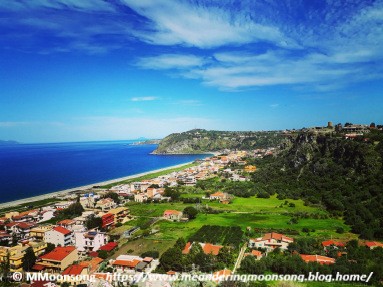
This particular historical gem, is in fact the largest castle to be found on this Mediterranean island, that is, the Castle and Citadel of Milazzo. Found in the small town of Milazzo, in the southern part of Sicily, this romantic architectural treasure is resplendently obvious as it is situated on a hill, majestically lording it over the nearby countryside and port.

When we arrived, the local old guy selling tickets immediately befriended us and launched into the history of the castle, boasting about it as though it was his own home. He told us how the site itself had first been fortified in the Neolithic era, then manned by the Greeks, and later conquered and enlarged by the Normans, the Romans, and later the Aragonese (Spanish). Actually, it’s me the guy latched on to, since my boyfriend does not understand Italian, however I obviously couldn’t stand there bantering all day, so we finally managed to excused ourselves and went into the castle itself.

And it was HUGE. First of all, let me be clear, when I say ‘castle’, I mean the whole citadel of course, that is the castle, grounds, and surrounding buildings. The grounds are quite big, though overgrown with local plants and wild flowers, which was part of their charm. There was an old but well kept church sporting some crumbling frescoes, as well as a number of buildings hosting a museum, a children’s area, and a number of rooms dedicated to the Second World War.

The real wonder of the site however were the medieval ramparts, where one could delightfully gaze at the spectacular panorama of town, port, sea, and countryside simultaneously. 360 degrees of paradise!

Yes please!

If you visit Sicily in the near future, make sure to save some hours for Milazzo Castle. You won’t regret it!

🙂

Exploring Venice on a Budget

When one hears the word ‘Venice’, the first adjective which comes to mind is ‘romantic’, the second one is, undoubtedly, ‘expensive’. This is what the majority of people think, and what I myself assiduously believed during my teens, when visions and dreams of visiting this unique floating city would cross my mind. Finally, a couple of years ago, I actually looked into the option of visiting Venice seriously, and when I did my research what I discovered was that visiting Venice was not at all as expensive as I had expected! On the contrary, going there for Valentine’s Day in February became an entirely do-able option. Of course, I had to do my homework first.

A commonly-made mistake is that of believing that because Venice Marco Polo Airport falls within the Commune of Venice itself, it is the most advantageous one. Personally, I found that using Treviso Airport instead was much less expensive, considering that this smaller airport caters for low-cost airlines. When it comes to flights, it is imperative to book at least six months in advance when travelling to very popular destinations such as Venice. This minimizes costs considerably, both when it comes to airport fees, as well as accommodation. The 2-hour flight from Malta to Treviso Airport for example, when using Ryanair, rarely costs more than €140, return and all, when this premise is taken into account. One can then buy a ticket for the shuttle bus either online or from the plane itself. The ATVO shuttle bus for example, costs only €18 (return ticket included) and left us right in Piazzale Roma in Venice. More information can be found on the official website here

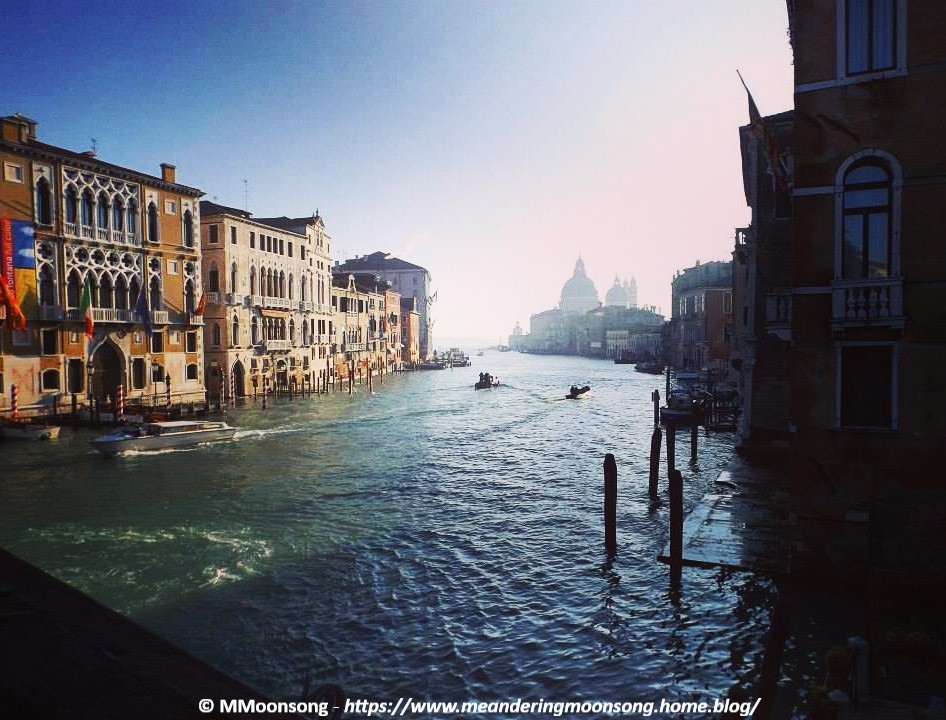
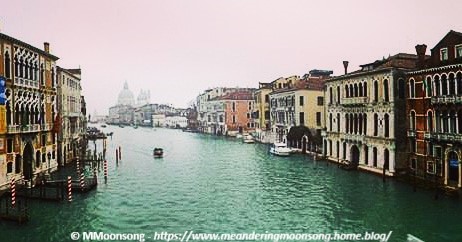
My heart soared as we booked the flights and shuttle bus, only to crash in despair as the time to start looking for a beautiful, clean and preferably central accommodation came closer. Beset by the idea that any hotel within Venice itself would be stratospherically expensive, I was actually flabbergasted when after only some minutes of searching I found what would be our refuge for our much dreamt-of four nights in Venice. Hotel Ca’ Zose , set in a 17th century building, is to be found squarely in the center of Venice, being almost exactly next to the famous Chapel of Santa Maria della Salute. This Chapel, built in 1681, is richly decorated with statues and a prevalent Baroque-style. Its two domes and two bell-towers dominate the skyline, and it is, in fact, present in most popular photos, pictures, and paintings emblematic of the city of Venice.

Venice has become widely known for its element of elegant decay. Its rich and diverse architecture, most notably the Venetian Gothic style of its Palazzi, combining Byzantine and Ottoman influences, has enchanted poets and painters, writers and musicians. This graceful style with its intricate designs, and rich window frames, is perfectly exemplified in the famous Palazzo Cavalli-Franchetti – a veritable dream upon the water.  Built in 1565, visions of the Palazzo delight anyone who ventures on the Grand Canal, not to mention offering various exhibitions and events throughout the year, since it is also the seat for the Venetian Institute of Sciences, Humanities and the Arts. I was also wowed by the beautiful Ca’ d’Oro, also on the Grand Canal, which with its floral Gothic architecture and colonnaded loggias, is a fairytale-like testament to Venice’s more prosperous past as a seaside port.

The Venetians prized every inch of land, not so surprising when one takes into account the huge number of canals running through the city, and the fact that throughout the years, slowly but surely, the land is being inexorably reclaimed by the sea. Its magnificent buildings are sinking, its charming artwork is slowly decomposing. This too, somehow, seems to add to its sad and sinister beauty. So much to see, so many entrance tickets to purchase, and yet, I still found a way to circumvent even this issue. Not by plunging head-first into palaces and art-galleries, forcing astonished receptionists and irate security-guards to come running after me, breathless with indignation – but by buying the Venezia Unica City Card. This is basically a card (or more accurately, a voucher), which offers the historically-minded traveler a chance to access a large number of monuments, churches and museums, including the famous Palazzo del Doge, by paying one single price, instead of purchasing a ticket at the door of each attraction. This is cheaper of course, if you are interested in visiting a certain number of such architectural gems. The Card also offers a number of other services, like a toilet pass and use of public transport. It can easily be purchased online here.

Venice is not a solid landmass, but an archipelago, that is, it consists of a myriad of tiny islands interlinked with bridges. On the first day of my stay, I was simply gutted to finally cross over to the district of San Marco, after walking across the famous and incredibly imposing Rialto Bridge, which is the oldest bridge spanning the Grand Canal. Flanked by small cute coffee shops and restaurants on the one side, and a market sporting Venetian masks, side-by-side with renowned brand-names like Louis Vuitton and Giorgio Armani on the other, this powerful structure built in the 12th century stretches between sea, sky, and land. It would have been utterly perfect, had it not been so hard to take a photo with all the hundreds of tourists jostling me, however finally I managed.

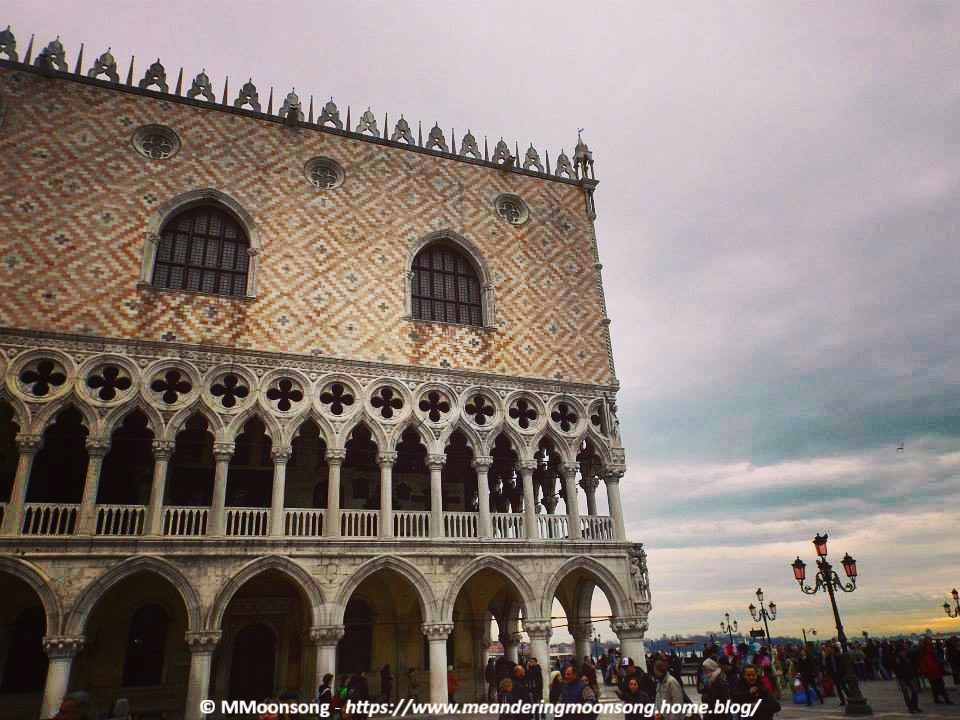
An important tip – don’t wear heels if you are going to be walking around Venice! Amazed by the grandeur of Piazza San Marco, flanked by Saint’s Mark’s Basilica and the Doge’s Palace, I couldn’t stop from gazing upwards, thereby causing the underside of one of my shoes to scrape the pavement the wrong way and the platform to literally disintegrate, resulting in a panicked and frenetic search for a pair of cheap yet comfortable shoes in the most expensive part of Venice. Fortunately, the Venezia Unica Card proved to be a blessing in this case as well, since afterwards, instead of having to wait behind interminable queues to enter the Italo-Byzantine Basilica of Saint Mark resplendent with gold designs and opulent mosaics, I could join those smart few who had already purchased their tickets online, and who were therefore waived through reception without delays. Next to Saint Mark’s Basilica, the Doge’s Palace, overlooking the lagoon on one side, and the Piazza on the other, houses one of the greatest museums in Europe, magnificently offering a glimpse of Venice’s opulent youth, through the Doge’s Apartments and the Senate’s Chambers. Its portego; a long corridor of Gothic arches, was truly a treat.

As I made my way back to the hotel on the last day of my stay, I also made it a point to look for and visit the Bridge of Sighs, adjacent to what was once the prison, and where convicts would, according to legend, take one last look at the world outside, before going to face their fate. Ironically enough, for a brief moment I could understand their sense of loss, since I too, was leaving Venice.

The Streets of Ghent and Antwerp

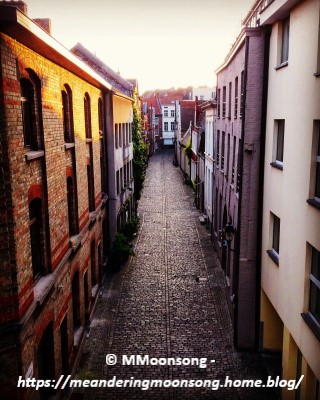
Waking up in Ghent is truly an experience. My room at the B&B I was staying in, was only a couple of floors up, however the night before, I had purposefully left the curtains of the two large windows open, so as to be able to see the sun rising over the medieval cobbled streets. Needless be said, I took the opportunity to take a couple of photos before going back to bed too.

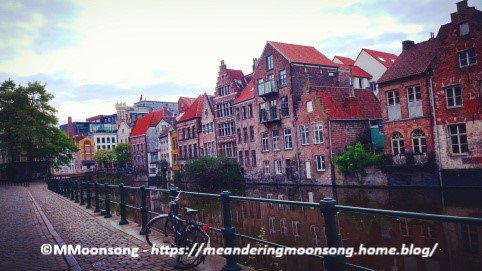
The romantic streets were silent and deserted so early in the morning. As I watched the alley across our room, an early-bird (possibly a baker judging from his overalls) locked his house behind him, got on his bike and pedaled off to work. Cars, of course, are not permitted within the small historic streets of Ghent. Only bikes. And boats of course. Did I mention the fact that Ghent is full of canals? Like Bruges, some actually call it the Venice of Northern Europe!

After another short nap, I heard the landlady tapping at my bedroom door, signalling that she had left the breakfast tray outside. As I opened the door, the scent of newly-baked bread almost made me swoon (she later told me that she went expressly for it at the baker’s at around 5.30am each day – blessed lady!). There were pots of jam, some delicatessen items, hot milk, eggs (we could prepare them on our small stove in the kitchenette as we preferred), etc… I must say it was one of the best breakfasts I ever ate. Obviously compounded by the peaceful medieval view from the breakfast table! While eating breakfast, I planned my day, which I was going to spend in Antwerp.

Antwerp, a Flemish medieval city in Belgium, is actually a port city, and its port is one of the largest in the world, ranking second in Europe. Its origins date back even before the 14th century. It has a large number of historical landmarks, not to mention cultural ones, since the artworks created by its famous 17th century school of painting (not to mention other arts such as weaving), were sought after throughout the world. Unfortunately, I was fully aware that I would be unable to visit as many of the places I was interested in, since I only had one day to spend in Antwerp, however I fully intended to try my very best.

After having taken the train from Ghent to Antwerp, while leaving the train station, I was immediately enchanted by the beautiful flowering streets of this sweet city. Colorful flowers and plants flourishing in the warm spring sun, decorated every corner, as people from every imaginable country, ethnicity and nationality thronged the pavements. Shops sporting popular brands abounded, however to be honest I was more drawn to the tall medieval gothic-style buildings which majestically reared their sculptured facades right next to them! It seemed like there was so much to see! Everywhere I looked, the past sat right next to the present, and the mad cacophony of everyday life vied with the dreamy awe galloping through my senses.


Suddenly, incredibly, I heard a burst of classical music. It was a grand piano! Yes, right there in the middle of the street! A street-artist had somehow transported his enormous polished piano amidst all the flowers, gothic palaces and grand stores, and was playing a sonata as though his heart would break. Tourists, locals, and passers-by thronged around him clicking away madly at their cameras and mobile phones. Talk about live street-art!

After the quite deserted streets of Ghent in the early morning, the bustling streets of Antwerp served as a real contrast. The multitude of shops, cafes, eateries, and museums to see in this city were overwhelming, yet there was also a strange atmosphere of calm – inviting you to just ‘browse and chill’… and boy did I love that!

To be honest, I do not know which I loved most – the street-life of Ghent or Antwerp. Both are uniquely beautiful and enriching in different ways.

What to wear at the Airport?

Your passport is in your handbag, you remembered to pack your moisturiser, your favorite scarf and your current read, and you’re ready to go… but are you?

Everyone looks forward to flying abroad for a holiday, away from the worries and cares of everyday life. There are also those who travel a lot for work purposes, and for whom catching a plane is as common-place as catching a bus. Be it work or pleasure, a two-week holiday or a two-day business trip, most people tend to plan and take great care when packing. We write lists and double-check everything in order to make sure not to leave anything important behind. This is all well and good, yet the time comes when all is set, the hour is finally upon you to drive to the airport… and we still have no idea what to wear for the journey!

Even though the end-game of travel is of course to arrive at one’s destination, the flight itself is important too, especially if it’s going to be a long one.

Most flights (at least in Europe) take approximately between two and five hours. Of course, this depends on the destination, and if you have an interconnecting flight or a delayed one, it takes even longer. You’ll be actively walking, carrying your heavy handbag, and lugging your even heavier and larger luggage around for at least half a day. Also, any responsible traveler makes sure to be at the airport at least an hour and a half before their flight, due to check-in and security.

Image source: ManchesterAirport

This is why it’s important for one’s travelling attire to be comfortable and practical. On the other hand, the clothes you’re wearing on your flight will most probably be those you’ll be wearing on the first day of your holiday, which is perhaps the reason why most people seem to sometimes prefer flashy fashion to actually being comfortable. Yes, it’s nice to be well turned up and pretty during your first day as a tourist in a new place. You’re obviously excited and looking forward to it. However it’s much more important to feel comfortable, in order to truly enjoy the experience to the max. Certain airlines even give points, an upgraded service, or some kind of bonus to those who are well-turned out (not many airlines in Europe do this). Some people like to compromise, however there are times when you must decide what’s more important for you – bonus points for being smart, or a comfortable flight (especially if it’s a long one from Europe to Asia for example).

Here are a few tips from an incorrigible globetrotter:

Make sure you have comfortable shoes! – This, I think, is the ‘One tip to rule them all’. I love shoes and I love heels, but unless you have absolutely no luggage (or a four-armed boyfriend acting as your personal porter), and won’t be crossing a number of busy airport aisles and check-ins, you really don’t need six-inchers at this point. Flat shoes or ballerinas are the best, clogs are fine, and shoes with short thick heels are passable, though still tiring in the long run. If you opt to wear boots, make sure your socks have no holes in them, since you might be asked to take them off at the check-in.

Image source: Health.harvard

Go for jeans or trousers – If you’re travelling for a work conference, to which you’ll be going directly from the airport, it’s understandable that you may want to look chic and professional when wearing your work clothes or business suit. This, however, does not mean that you can’t be practical. Tights have a habit of mysteriously ripping and getting seams, projecting an untidy or slatternly look. This is definitely not something you’d want during an important meeting. It’s therefore better to opt for trousers, a shirt, a smart blazer, and be done with it. Better safe than sorry!

Image source: Starstyle

Wear layers, even in summer – The air is colder in high altitudes. True, you’ll be on a plane, but the chilly air will still get to you, especially if you’re travelling at night. On the other hand, during a long flight, you might get stuffy and feel cooped up and squashed between so many people, unable to move around. It very much depends on the individual, and you could feel cold one minute and uncomfortably warm the next. It’s therefore better to be prepared.

Image source: Trendspotter

Follow airline regulations – Ensure that there are no liquids, sharp objects or metallic accessories in your hand luggage if possible. That is of course, unless you’re into being taken aside and inspected by security personnel while the huffing and puffing people behind you grumble and throw you dirty looks!

A version of this article, written by yours truly, was originally published on EVE magazine.

Ghent by Night

Ghent by night is a magical place. I arrived from Brussels Airport by train at around 8pm, then took a tram which left me very near my B&B. Actually, the tram left me right in front of the Gravensteen, which is a medieval castle right at the heart of the tiny cobbled city. The Gravensteen, originally built in 1180, had served as the seat for the Counts of Flanders until the 14th century, and was brought to life again in 1885 by the City of Ghent, which renovated it.

The Gravensteen

Needless to say, the sight of those historic ramparts glimmering like a fairytale at 9.30pm, was a real sight for sore eyes, especially after a journey consisting of 2 hours waiting at the airport, a 3.5 hours flight, a 1 hour train, and the 10 minute tram (yes that last one bears mentioning too lol).

I was travelling with only my hand-luggage, since I was only staying for the weekend in Belgium, however I was so tired, that even the hand luggage actually seemed to weigh much more than it did. The beauty of Ghent by night almost forget my tiredness though.

At that point I was feeling kind of hungry plus I really needed to sit down. The trip hadn’t been exactly ‘relaxing’ either. As I walked slowly down the main cobbled streets around the Gravensteen, young people and tourists thronged the many small bars and cafes dotting the landscape. Most of these, I was overjoyed to note, sported windows full of a myriad of different types of beers and ciders! What can I say – I simply had to stop for a drink! Not to mention, take the opportunity to buy a cone of the famous Belgian chips, which, placed in (yes) a cone of rolled-up newspaper, seriously rivaled those of Britain… and the sauce! Omg!

Thirst and hunger appeased, I walked on towards my cozy bed and breakfast. As I rang the doorbell and waited in the nippy chill (it WAS around 11pm by this time), a sweet eccentric lady opened the glass door, while a black and white cat bumped jocosely around her feet. The Lady, I was to learn later, was a live-at-home artist whose Asian-inspired paintings belied the fact that she was a spiritualist and a Buddhist (she was Belgian, but had traveled extensively to Asia). Honestly, I wish I had had the time to strike up a real friendship with her, but I was there to explore Belgium and enjoy the weekend after all, not spend the time with my landlady hehe.

The b&b was simply charming. There were only two rooms to let. The room I had chosen was called ‘The Peacock Room’, and it was decorated in a vintage chick style. The color was, of course, peacock blue, and the walls had been painted with a couple of interesting murals by the landlady herself. The double canopy bed was adorned with Chinese lanterns and wind-chimes. There was also an ensuite bathroom and a tiny kitchenette with a well-stocked fridge, and complete with a small collection of quirky teapots!! Cute!

Being really exhausted at this point, I just took a quick shower and did some minor unpacking, before going to bed. The quick look I had managed to take at Ghent, not to mention the unique style of the room, had only whetted my appetite for more.

What can I say? Ghent – it was love at first sight! And this was only the beginning of my weekend in sweet Belgium…

A Sea Adventure – The Inner Hebrides Archipelago in Scotland!

As the ferry broke away from the mainland and onto the cold Atlantic, I clapped on my fluffy ear-muffs and took a deep breath of the freezing pure air. I was crossing the Atlantic Ocean from the seaside town of Oban, on the West Coast of Scotland, towards the Isle of Mull, one of the largest islands within the archipelago known as the Inner Hebrides.

The port of Oban

My camera clicked madly as the crossing took us through a large number of small islands, both habited and uninhibited, which form part of this archipelago. Random ruined castles, modern lighthouses, tiny hamlets, and small forests standing proudly amidst the roar of the surf, filled my vision.

The one-day trip to visit three of the most famous islands within the Inner Hebrides had not been a spur of the moment decision. We had in fact, booked and paid for it online weeks before actually setting foot on Scotland, in order to make sure that the date was solidly set beforehand. We were lucky in that we managed to visit during the last week of September, since passage for tourists to two out of the three islands we were visiting, is never possible during winter-time. Bookings were accepted up to the beginning of October, subject to weather conditions of course.

Oban – On the West coast of Scotland

Leaving our rented car parked snugly at Oban, we collected our combo-tickets from the ticket office, and set off towards the Ferry Terminal Railway Peer. There are a number of cruise companies which offer combo tickets at not much more than £45 per person. Such tickets usually include all the ferries to and from the specific islands one wishes to visit, as well as any possible coaches or busses, and the relevant guides. In our case, we opted to visit the Islands of Mull, Iona and Staffa.

The comfortable ferry, which sported a wine-bar and cafeteria, made port at Craignure on Mull, the second largest island in the Inner Hebrides after the Isle of Skye. We were greeted by our coach-driver and guide, who was herself a native of Mull, and who proceeded to drive us around the picturesque island for around an hour, recounting anecdotes about the various ruins, legends, and even personages who had lived there. I must admit that without her lilting cheerful voice narrating so many colourful stories, I might have started to feel a little cramped at this point. This was because we had no time to stop anywhere or to walk around and visit Mull properly, since we had to travel directly to Fionnphort on the other side of the island, in order to catch yet another ferry to the Isle of Iona. The day was cloudy, windy and quite cold, and the gentle Scottish rain pattered on the windows of the coach, making it impossible for us to take any photos along the way. We could still admire the isle itself though. A lush picturesque symphony of moorland, mountain scenery and coastal views, dotted with small cottages and many many sheep. Our guide informed us that on Mull there were in fact three sheep for every human being.

The Isle of Iona

The ferry we boarded at Fionnphort was markedly smaller than the first one. There was a middle space reserved for one or two small cars, and some railings for pedestrians to perch on at the sides. The presence of the wind was much more pronounced on such a small craft. A couple of dogs yapped steadily as we bobbed up and down towards the smaller, yet more well-known island of Iona. Renowned for its natural beauty, Iona is famous for its Abbey, which is the one of the most elaborate and best-preserved ecclesiastical building surviving from the Middle Ages. The Abbey is of particular historical and cultural interest in that it was here that Saint Columba, who brought Christianity to Scotland from Ireland, settled and built his first monastery. It is also the place of origin of the wondrous Book of Kells, an illuminated manuscript which is today kept at Trinity College in Dublin.

Iona Abbey

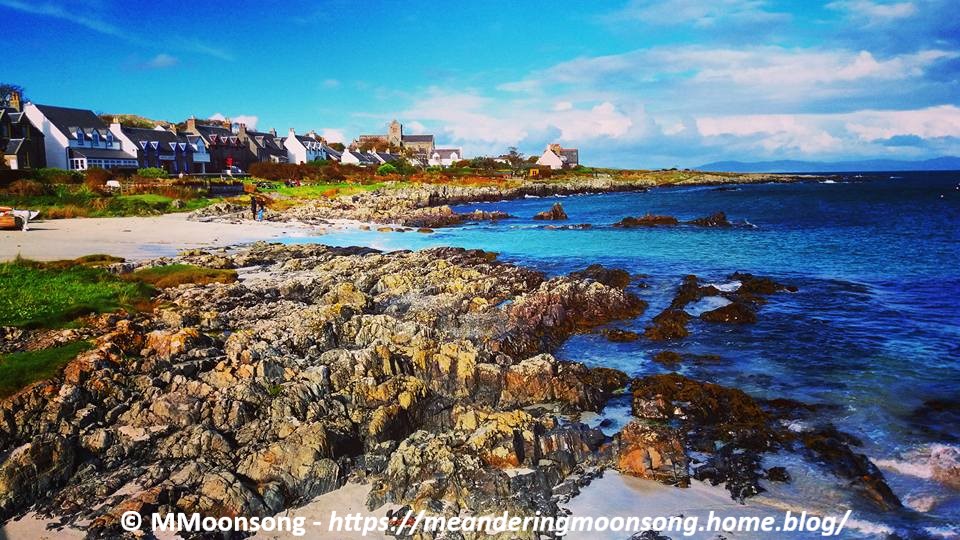
Personally, I am not much of a religious pilgrim, yet history, art and architecture fascinate me, which is why the Benedictine Abbey of Iona attracted me so much. The medieval arches, romantic columns, and amazingly crafted stained glass windows were the perfect complement for the natural landscape of the Hebrides. Shaggy highland cows with long horns and a peaceful expression looked at me quizzically while I breathed in the salty air and strolled along the rugged beach directly behind the Abbey. The chill actually got to me at this point and I was very happy to purchase a pair of white cotton ear-muffs from the Abbey’s souvenir shop itself. I must have been quite a sight. Perhaps that’s why the cows were staring at me.

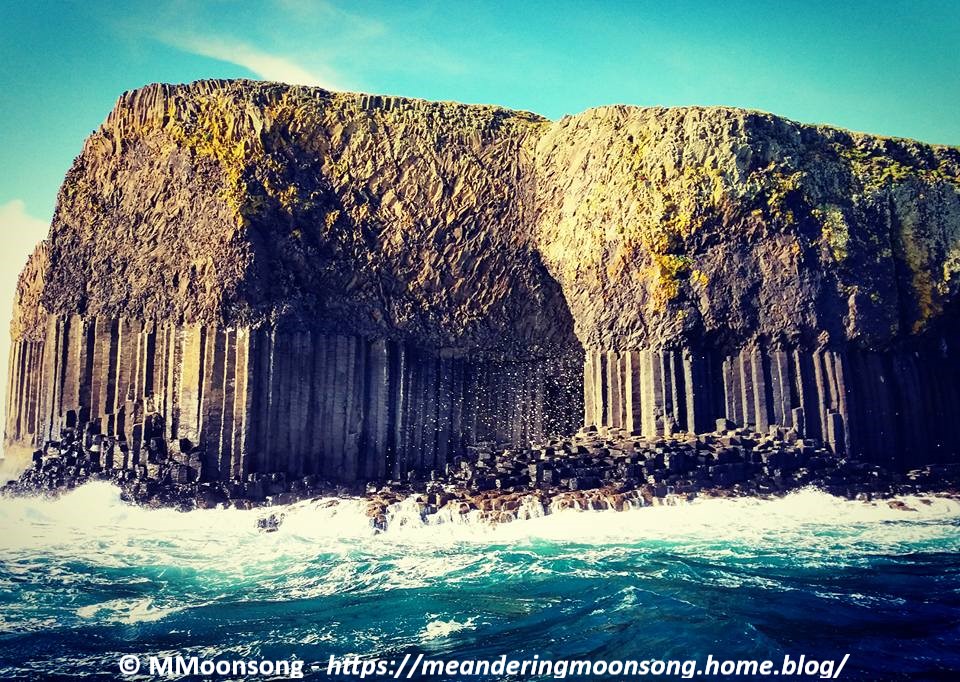
After eating some lunch at one of the handful of small pubs on Iona, we prepared for the highlight of the day – the trip to the mythological tiny island of Staffa, and the visit to the legendary Fingal’s Cave. Being part of a Nature Reserve, and managed by the National Trust for Scotland, Fingal’s Cave is a unique natural monument formed entirely of hexagonally jointed basalt columns, similar to the Giant’s Causeway in Ireland, which I had visited a couple of years back.

We boarded an even SMALLER boat (our third one), with a capacity of not more than 25 people. The wind had really picked up at this point, and I started to get a tiny bit worried. What’s more, before starting the craft, the captain said that he had to inform us that the crossing would not be an easy one, and that in fact some people from an earlier cruise had been pretty sick. Going to the Isle of Staffa and back was going to take us approximately an hour and a half of sailing. He asked us if there was anyone who preferred to remain on land and be reimbursed the trip, since he would not be taking responsibility for any accidents. Five people got off the boat. I was scared to death. My boyfriend was looking at me breathlessly, excited by the prospect of such an adventure. I gritted my teeth and sat down. How bad could it get? Right?

All went well at first. The wind was behind us, so the boat crested the waves blithely and I got used to the rock and roll motion of the deck. It was fun actually. The waves sprayed all over us as we tried to keep steady enough to use our cameras. There was so much to take in! The Inner Hebrides are comprised of 35 inhabited islands and 44 uninhabited ones, and Staffa is one of the latter. As we drank in the blueness of the sea and sky around us, caught between them like flies in amber, our captain told us of the facts and legends surrounding Fingal’s Cave. The 72 feet tall and 270 feet deep cave itself was known to to the ancient Irish and Scottish Celtic people as Uamh-Binn, meaning ‘the Cave of Melody’, due to the eerie sounds which emanate from its arching cathedral-like features when the wind and the echo of the waves sound just-so. Legend has it that the Irish warrior and leader Fionn mac Cumhaill, who was as big as a giant, built a bridge here between the Isle of Staffa and the Giant’s Causeway in Ireland, in order for him to reach his nemesis and rival Benandonner. The legend which connects the two structures is geologically correct in fact, as both of them were created by the same ancient lava flow, which may have, at one time, formed a ‘bridge’. We are talking of around 60 million years ago here, so there were no human beings around to see it at the time.

Fingal’s Cave on the Isle of Staffa
The fractured columns on the Isle of Staffa

As we got closer and closer to the islet and to the cave itself, anything seemed possible. The cave has a large arched entrance and is filled by the ocean. When I had booked our cruise, we had been promised that we could actually land on the island and walk the short distance to the cave, where a row of fractured columns form a walkway just above water level, permitting exploration on foot. Unfortunately, the captain at this point informed us that the sea was becoming too rough, and that landing was dangerous. So, we had to be content with looking closely at the island from the sea. We didn’t even enter the mouth of the cave. I admit that I was, and still am, bitterly disappointed about this. Scottish weather is fickle and changeable however, especially at sea, so there was nothing to be done. It was after all, the end of September. I would strongly recommend anyone who would like to visit the Hebrides to go during high summer, when the weather is calmer.

Seeing Fingal’s Cave, even from afar, was a great experience. No wonder the famed composer Felix Mendelssohn was inspired to create ‘The Hebrides Overture’, also known as ‘Fingal’s Cave’, after visiting in 1829! Famous landscape painter J.M.W Turner painted it, William Wordsworth, John Keats, Lord Tennyson and Queen Victoria all expressed amazement after visiting it, and Pink Floyd even named one of their earliest unreleased songs after the cave.

Coming back, all the feelings of awe and amazement totally fled. The sea had gotten even rougher, and this time, the boat was going against the wind. I don’t usually suffer from sea-sickness, but that trip was truly a nightmare. I sat down in a corner, held on for dear life, and ended up hugging a fire hydrant in an effort not to fall or roll off, as the now huge waves crashed against the tiny boat and all the other passengers gasped in terror, trying not to cry out. I admit, those were the longest 45 minutes of my life. Cutting a long story short, after our arrival at the Isle of Mull, we still had to suffer through an hour-long trip in the coach, and another 45 minutes on the ferry from Fionnphort back to Oban where we had left the car.

It wasn’t an easy journey to say the least, but the enchantment of Fingal’s Cave, the charm of the Inner Hebrides, and the depth of emotion I felt there, will be truly remembered forever. As will, unfortunately, the hellish boat-ride amidst the stormy Atlantic Ocean!

A slightly different version of this article was originally published on The Sunday Times of Malta.

The Importance of Preparation

When your target is to see and experience as much as you can within a particular period of time, you generally try to save time by planning as much as you can beforehand, in order to be able to sight-see as much as possible, in the few days (or if you are lucky, weeks) you have abroad. Sometimes, it may even feel as though you are running against the clock. The trick is to get all the planning and research done before you are actually on your holiday, and not after you have arrived at your destination per se.

Here are some tips which could help you prepare for your much-awaited adventure:

1. Set your dates and buy your flight: Make sure that you are free of work / school / any other appointments and as soon as you are sure, book those flights IMMEDIATELY! Flight prices tend to go up closer to the date, so the first thing to do is to get that out of the way, especially if you are on a budget!

2. Budget: See how much you can really spend, taking into account accommodation, travelling expenses, food, museum / castle / events tickets, not to mention shopping!

3. Decide which part of the country you are going to use as your base: If you are staying at the city center, then obviously your accommodation should be situated there. If, on the other hand, you are exploring a remote part of the country, or going on a road-trip, you might even decide to stay at two or three different locations, in order to be able to continue with your journey as you go along, instead of having to always return to the same bed.

4. Decide on a mode of transportation: How will you get from the airport to your accommodation? Are you renting a car? Will you be using public transport throughout your stay? Are you visiting a friend who will drive you around wherever you wish to go? All this must first be taken into account before actually starting to work on the ‘meaty’ part of the holiday.

5. Once all that is settled and decided, what I usually do is draft a small table or list, starting with the day and time I will be arriving at my destination, and the time I will be leaving. All the space in between is a blank canvas, to be filled in depending on one’s personal agenda and where you wish to go. Take out your map (or better still, go on Google Maps) and start tracing an imaginary line around it and have fun filling in that gap!

Image source: Museivaticani

6. If you know you are visiting a certain place on a certain day for sure, and you find that you can buy the ticket to the place / event online, do so! In most cases, the price will be cheaper if you buy it online, not to mention the most important fact that you will be saving time in which you could be doing something else instead of waiting around in queues!

7. If you have a GPS or a map, mark down the locations where you are certain you would like to go. This will help you find the place more easily when you are actually there. Getting lost is a big NO-NO when it comes to saving time.

8. Try and calculate how much time you will need to travel between one destination and another. For example, if you need to take the train from London to Kent, where you have to attend a specific event or visit a particular place before closing time, check how much time you require for travelling.

9. Check whether the places you wish to visit have opening hours and what they are. It would be pointless to go somewhere and then realize that they have just closed or that they do not open on certain specific days and you end up being there on one of them! I bless the internet on these occasions as almost all the information required can be found online.

10. Pack up your maps, your tickets, your receipts, lists, tables and what-have-you in a sturdy file or folder. This may seem trivial but believe me, you don’t want to lose anything or end up with rain or mud splattered on your tickets, and not be able to enter your chosen location because the person at reception just does not believe you have already paid.

Too much trouble you think? Well personally, I think it’s more than worth it, as once you are at your destination, you end up just enjoying yourself and living in the moment, instead of having to worry about all this stuff.

Bon Voyage!!

Remembering Utrecht

Following the Dutch shooting which took place on a tram in Utrecht three days ago (read all about it here), I can’t help but remember the beautiful day I spent in Utrecht when I visited in December 2017.

It was a clear crisp winter day. The sun was shining, white snow lay everywhere from the previous night, the air was refreshing, and the cobbled streets of the medieval city center bustled with joyous students on bikes, excited tourists and busy locals. The scent of freshly baked bread was in the air, and colorful flowers adorned many shop-fronts.

The canals were so pretty in the early morning light! It is such a romantic city.

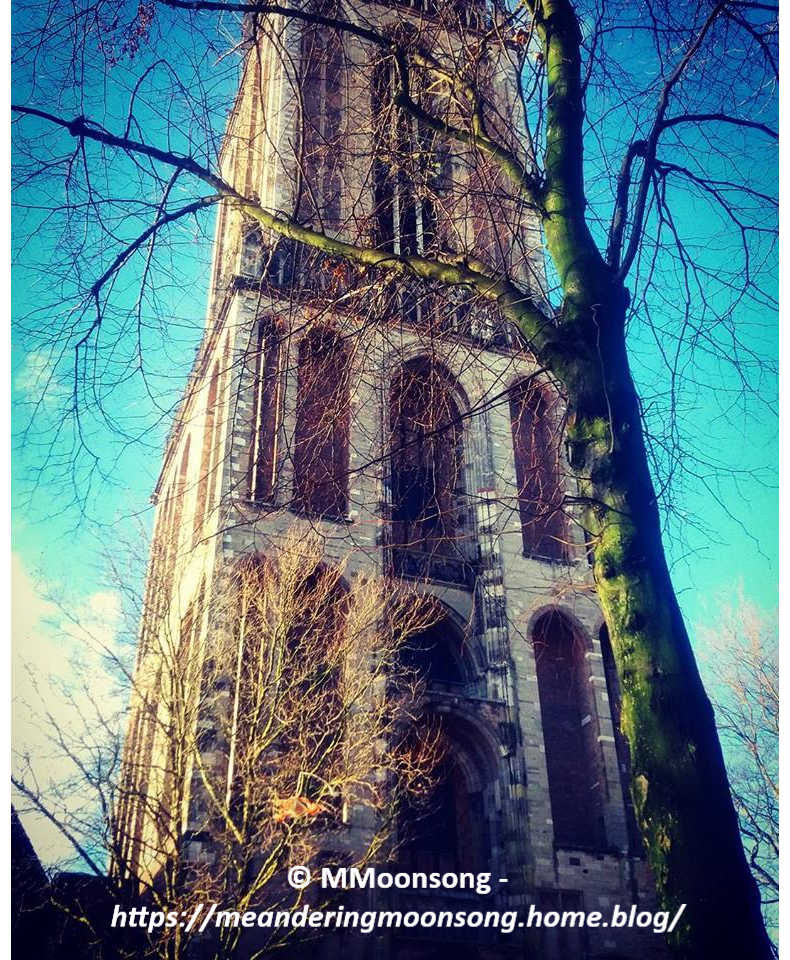
My first stop was gothic Saint Martin’s Cathedral. Although the current cathedral was built in the 13th century, it rests on a much older church which had been damaged in a fire. The church itself had been built on the ruins of a Roman fortress.

The cathedral’s vaulted interiors, stained glass and beautiful sculptures are really a sight to behold, and I was truly enchanted by the atmosphere of mystery and historical meaning attached to it.

Apart from the Cathedral, another amazing stop in Utrecht is the Dom Tower, which is the tallest church tower in the Netherlands. The tower was built in the 14th century to showcase the power of the city, and with its 14 enormous bells and incredible height, it surely does that!

Unfortunately I was suffering from severe back problems caused by a slipped disc at the time, so I wasn’t able to climb up the 465 steps to the top of the Dom Tower (there is no lift). Instead, I walked around the city, enjoying its flavor.

Needless be said, I somehow gravitated towards the local bookstore (for those who haven’t taken a peek at the ‘About Me‘ section yet, I’m a total bookworm and book-hoarder) and I took the opportunity to purchase Isabel Allende’s ‘Eva Luna’, which I had been hankering after for some time.

After walking around some more, I stopped at a pretty little bar for my lunch, and even tried out one of the local beers.

There are many other attractions to be found in the city, such as the Central Museum, the Railway Museum, the underground archaeological ruins, Utrecht Botanic Garden and the Grand Canal, among others.

Later on in the day, after having enjoyed roaming around the city to my heart’s content, I visited the Castle De Haar, which is to be found around half an hour away (by car) from the city itself. This fairytale location however deserves a blogpost of its own,… more later 🙂

Using Land Transport

Whenever I’m conversing with someone about travel and holidays, it’s surprising how many people seem to find land transport to be one of the most difficult issues to navigate through (pun intended).

Travel, in my opinion, is all about adventure and exploration. I’m not one to spend hundreds of euros to travel to a beach to relax somewhere, which I can very well do in Malta or Gozo (my home-country) anyways. Instead, I prefer to see as much of the country I’m visiting as much as I possibly can.

So, when people ask me how I managed to see so many different attractions and places in such a short space of time, it’s mainly because most of them seem to have difficulty with sightseeing when the locations they want to reach are not conveniently placed in a capital city, or in a major urban area. Well, guess what? Aside from taxis (which are too expensive and inconvenient most of the time), there are actually many other easy and economical ways of travelling on land when you are in a foreign country. All it takes to be aware of them is some online research – and for this, I’m eternally grateful to the founders of google.com, Larry Paige and Sergey Brin.

Here are some ideas to help you out with regards to land travel when abroad:

The Tube/Underground/Metro

Granted, this mode of transport is not to be found everywhere, however the network is much vaster than one might believe. Although the London Underground is the most well-known and the oldest system of its kind, there’s actually a vast list of countries which make use of it. These include Algeria, Austria, China, Germany, Belgium, Russia, Japan, Italy, USA, Switzerland, Spain, and many others. The underground is usually my preferred mode of transport to and from the airport, since it’s not only economical, but also very convenient as most airports sport an underground station directly next to, if not beneath them.

Image source: BusinessInsider

Train Stations

The first recorded train station started to be active in 1803. Nowadays, efficiency and easy access to tickets have soared, in that not only can you purchase tickets from automated machines within stations themselves, but also online, which can be done days, if not weeks in advance, foregoing long queues. Railway tracks pass through mountains and valleys, operating cross-border through different countries and states. Most airports are found within at least one or two railway routes, as are a large number of remote countryside towns and even villages, aiding one in travelling across the length and breadth of most countries around the world in a relatively easy manner.

Image source: Londontoolkit

Private Coach

This is a service provided by a number of companies worldwide. Coaches are usually available from a number of focal points, such as airports or key points within the city centre, or even in front of specific hotels. All the traveler has to do is book their passage online at the time and place desired, and they’ll be automatically pooled in with a number of other passengers. Coach routes can vary, ranging from one-hour to twelve-hour journeys or more, and they’re usually furnished with bathrooms, luggage compartments, nightlights, and even beverage-machines. Most coach services are advertised in airport websites themselves, so that’s a good place to start choosing one.

ZPY_300_Zarb_Coaches_IVECO_Eurorider_C33_-_Hispano_Divo._Malta
Image source: Wikimedia

Public Buses

Although these operate mostly in and around cities, towns and suburbs, it’s still worth checking out the relevant timetables before making plans for sightseeing routes, in order to already have the times and distance between different attractions already in mind when you start out. Also make a note on night bus routes, which may be different from the day ones. Bus tickets can usually be purchased as block tickets; instead of buying a ticket each time, you can buy a 3-day ticket or a weekly ticket, depending on how many times you think you’ll be making use of the service. This could save time as well as money.

tal-linja2
Image source: Tvm

Car Rental

If you’re travelling in a group, or even as a couple or on your own, and if, of course, there’s at least one driver in your group who doesn’t mind driving abroad, this is perfectly ideal. Nowadays, there are a large number of reliable Sat-Navs (GPS) on the market, which are much more efficient than the old map-and-directions routine. Of course, it’s always advisable to look up the locations you’re visiting beforehand, and get the lay of the land. I would also recommend using Google Earth and zoom in on street view, in order to virtually acquaint yourself with the surroundings you’re about to travel through. Be especially careful if you’re going to visit a country where people drive on the other side of the road, as this may take some getting used to.

123

Image source: Gozoandmalta